
Table of Contents
- What Is Flat Rate Processing?
- How Flat Rate Pricing Works
- Interchange-Plus vs Flat Rate: The Real Cost Difference
- The Break-Even Volume Threshold for Flat Rate
- Average Credit Card Processing Fees by Industry
- How to Lower Credit Card Processing Fees
- Is Flat Rate Right for Your Business?
- Frequently Asked Questions
Last Updated: September 25, 2026
What Is Flat Rate Processing?
Flat rate processing charges a single, fixed percentage on every credit card transaction, regardless of card type or transaction size, simplifying the fee structure compared to the traditional interchange-plus model.
This approach appeals to business owners because it eliminates complexity: a 2.9% flat rate applies equally to a $100 transaction and a $10,000 transaction, with no variation based on card type.
The trade-off: flat rate works well for some businesses, but the question of whether is flat rate processing good for high volume has a straightforward answer, it typically is not for high-volume operations.
How Flat Rate Pricing Works
Flat rate processing applies one percentage to every transaction. The processor deducts the agreed-upon percentage and deposits the remainder into the merchant’s account.
The calculation is straightforward: a 2.9% flat rate on $1,000 costs $29; on $100,000 monthly volume, total fees are $2,900. The rate remains constant regardless of card type.
Most flat rate processors also charge a per-transaction fee (typically $0.20-$0.30), which adds a fixed cost to every payment. A $50 transaction might cost $1.45 total (2.9% plus $0.30); a $500 transaction costs $14.80.
The per-transaction fee is where flat rate processing often catches businesses off guard. High-volume merchants processing thousands of small transactions can see their effective rate climb significantly due to accumulated per-transaction charges, even though the percentage appears competitive.
Flat rate pricing typically includes PCI compliance support and basic reporting. The appeal is simplicity: no need to understand interchange rates or qualified vs. non-qualified transactions.
Interchange-Plus vs Flat Rate: The Real Cost Difference
Interchange-plus (cost-plus) pricing charges two components: the actual interchange rate set by card networks, plus the processor’s markup.
Interchange rates vary by card type, transaction category, and business sector. Retail stores typically see 1.5%-2.5%; high-risk industries see 2.5%-3.5% or higher. Processors add a markup of 0.5%-1.5% on top.
With interchange-plus, a business processing mostly standard Visa and Mastercard might pay 2.2%-2.8% effective rate. Corporate or rewards cards trigger higher rates, pushing the effective rate to 3.0%+.
Flat rate eliminates this variability, 2.9% on everything. This sounds attractive until significant transaction volume is processed.
A merchant processing $100,000 monthly pays $2,300 under interchange-plus (2.3% effective) versus $2,900 under flat rate (2.9%), an extra $600/month or $7,200/year. At $500,000 monthly, the difference is $3,000/month or $36,000/year.
Flat rate becomes competitive for retail stores with mostly standard Visa/Mastercard sales (already high interchange costs). Subscription businesses benefit from interchange-plus because recurring transactions qualify for lower rates.
The National Retail Federation’s payment processing analysis documents how transaction mix and volume affect which pricing model delivers better value for different business types.
The Break-Even Volume Threshold for Flat Rate
The break-even volume threshold is the monthly transaction amount where interchange-plus becomes more cost-effective than flat rate. This is the most important calculation a high-volume merchant can perform, yet most never run the numbers.
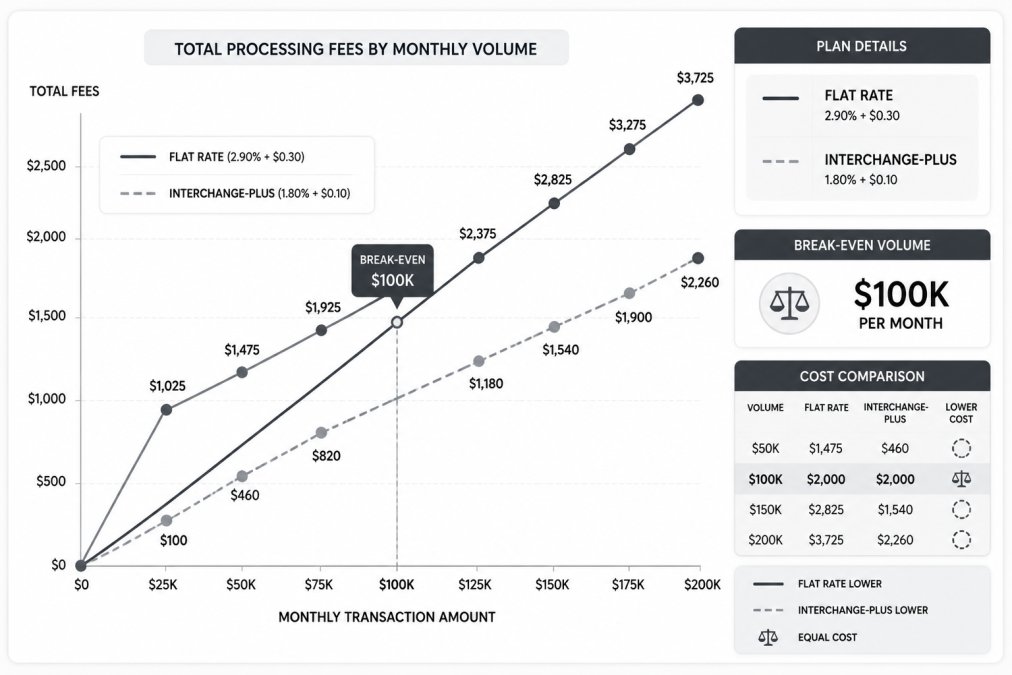
How to Calculate Your Break-Even Point
Calculating this threshold requires: (1) your effective interchange-plus rate, (2) your flat rate percentage, (3) per-transaction fees under each model, and (4) your average transaction size. The formula: at what monthly volume do total fees equal each other?
Example Calculation:
- Current flat rate: 2.9% + $0.30 per transaction
- Quoted interchange-plus: 2.2% + $0.25 per transaction
- Average transaction size: $150
At $100,000 monthly: flat rate costs $3,100 vs. interchange-plus at $2,367 ($733/month savings). At $50,000 monthly: flat rate costs $1,550 vs. interchange-plus at $1,183 ($367/month savings). Interchange-plus becomes advantageous at roughly $30,000-$40,000 monthly volume.
Why Average Transaction Size Matters
Average transaction size dramatically affects break-even points. A coffee shop processing $80,000 monthly in $15 transactions (5,333 total) pays $1,600 in per-transaction fees alone; a B2B software company processing $80,000 in $5,000 transactions (16 total) pays only $4.80. The coffee shop’s break-even is $150,000+ monthly; the software company’s is $40,000 or less.
Industry-Specific Break-Even Ranges
Industry-specific break-even ranges: Retail $80,000-$120,000 monthly; E-commerce $60,000-$100,000; Subscription $30,000-$60,000; High-risk $40,000-$80,000; B2B services $20,000-$50,000.
A business processing $150,000 monthly might assume a 2.9% flat rate is reasonable, but if its actual interchange-plus effective rate is 2.2%, it’s overpaying by $1,050 per month. That’s $12,600 annually in unnecessary fees, money that could fund operations, hiring, or growth. Many merchants discover they’ve been overpaying for years because they never calculated their actual break-even point.
Getting Your Numbers
Gather from your merchant statements: total monthly volume, transaction count, total fees paid, and card mix breakdown. Request a detailed statement from your processor if needed. Once you have these numbers, model the cost of switching to interchange-plus. Many merchants discover they crossed their break-even threshold months or years ago.
Average Credit Card Processing Fees by Industry
Retail sees effective rates of 2.2%-2.6%; e-commerce 2.6%-3.2%; subscription 2.0%-2.5%; high-risk 3.5%-4.0%+. Flat rate is most attractive for industries with high interchange rates and moderate volume. It becomes less attractive as volume increases or in categories with naturally lower rates.
How to Lower Credit Card Processing Fees
Reducing payment processing fees requires understanding the specific cost drivers for a business and then addressing them systematically. For high-volume merchants, the approach differs depending on whether a business is using flat rate or interchange-plus pricing, and negotiation becomes a critical lever.
Step 1: Determine Your Actual Cost Position
Calculate your effective rate (total fees ÷ total volume) and compare to benchmarks. If on flat rate and overpaying by $500-$1,000+ monthly, you have negotiating leverage. If on interchange-plus, request an itemized statement showing interchange rates by card type, processor markup, assessment fees, and per-transaction fees. Compare against benchmarks: retail 2.2%-2.6%, e-commerce 2.6%-3.2%, subscription 2.0%-2.5%.
Step 2: Prepare Documentation and Leverage
Gather 12 months of transaction data (volume, count, average ticket, card mix, chargeback rate), your current processor statement, written quotes from 2-3 competitors, and documentation of volume growth. Volume is your strongest leverage point.
Step 3: Initiate Negotiation
Contact a merchant services manager or account executive (not customer service).
Processors have more flexibility than they initially reveal. A customer service representative may say “rates are non-negotiable,” but a merchant services manager has authority to adjust rates, waive fees, or modify terms. Always escalate beyond the first line of contact.
Step 4: Negotiate Specific Fee Components
-
Interchange-plus markup (basis points): This is the processor’s profit margin above the wholesale interchange rate. For high-volume merchants, this should be 0.25%-0.75%. If you’re paying more, this is the first target.
-
Per-transaction fees: These accumulate quickly. Reducing from $0.30 to $0.25 per transaction saves $167 monthly on 10,000 transactions. Negotiate this aggressively if you process high transaction counts.
-
Monthly minimums: Some processors charge monthly minimums ($25-$50). If your volume is high, these should be waived entirely.
-
PCI compliance fees: These are often negotiable or waivable. If you maintain PCI compliance independently, request that this fee be removed.
-
Batch fees, gateway fees, or other ancillary charges: These are often the easiest to negotiate away because they’re not core revenue for the processor.
Step 5: Reduce Chargebacks and Compliance Issues
Implement:
- Clear return and refund policies displayed prominently at checkout
- Descriptive billing statements so customers recognize charges
- Proactive customer service communication (order confirmations, shipping updates)
- Fraud detection tools (address verification, CVV matching, 3D Secure)
- Clear cancellation processes for subscription services
Step 6: Optimize Your Transaction Mix
- Offer small incentives for lower-cost payment methods (ACH transfers, debit cards)
- For subscription businesses, encourage customers to use standard Visa/Mastercard rather than American Express (which has higher interchange rates)
- For B2B businesses, negotiate with large customers to pay via ACH or wire transfer for orders above a certain size
Step 7: Know When to Switch
- Signing an agreement with the new processor
- Updating payment terminals or gateway settings
- Notifying customers of any changes (usually none are visible to them)
- Closing the old merchant account (watch for early termination fees)
The most effective cost reduction comes from matching the pricing model to your actual business profile and then negotiating terms appropriate for your volume. A business with $200,000+ monthly volume should be on interchange-plus with a competitive markup. A business with $30,000 monthly volume in a high-risk category might benefit from flat rate. Using the wrong model or accepting non-competitive rates within the right model is the biggest cost driver, and it’s entirely within your control to fix.
Is Flat Rate Right for Your Business?
Determining whether flat rate processing is appropriate requires honest assessment of transaction volume, card mix, and industry category, and ultimately, whether is flat rate processing good for high volume in your specific situation.
Frequently Asked Questions
At what monthly processing volume does flat rate processing become more expensive than interchange-plus?
The break-even point depends on your average ticket size and industry, but most high-volume merchants see flat rate become expensive between $30,000 and $50,000 in monthly processing volume. Once you exceed this threshold, the fixed percentage of flat rate pricing typically costs more than the variable interchange-plus model. Your actual break-even volume requires analyzing your processing statement to calculate your effective rate under both models.
What hidden costs are included in flat rate payment processing?
Flat rate pricing often masks assessment fees, PCI compliance charges, monthly gateway fees, and chargeback fees that aren’t immediately visible. Some processors also apply higher rates for certain card types (corporate or international cards) while still calling it ‘flat rate.’ Always request a detailed processing statement showing all fees separately so you can identify the true cost of acceptance.
How does interchange-plus pricing compare to flat rate for high-volume merchants?
Interchange-plus pricing charges you the actual wholesale rate set by credit card networks plus a fixed markup from your processor. For high-volume merchants, this model typically costs 0.5% to 1.5% less than flat rate because you pay only the true interchange cost rather than a processor’s average estimate. The trade-off is more complexity in your processing statement, but the cost savings usually justify the added transparency.
Is a 3% transaction fee considered high for high-volume operations?
Yes. A 3% flat rate is high for businesses processing over $50,000 monthly. Most high-volume merchants should expect effective rates between 1.5% and 2.2% under interchange-plus pricing. If you’re paying 3% and processing significant volume, you’re likely overpaying by hundreds of dollars monthly. Request a cost analysis from your processor or seek a consultation to identify where savings can be found.

