

Table of Contents
- The ‘Instant’ Myth vs. Reality: What Merchant Account Approval Actually Takes
- How the Merchant Account Approval Process Works
- Merchant Account Application Checklist: Documents You Need Now
- High-Risk vs. Low-Risk: How Classification Affects Your Timeline
- High Risk Merchant Account Providers: What Sets Them Apart
- Choosing a High Risk Payment Gateway: Speed vs. Stability
- Common Reasons for Application Denial and How to Avoid Them
- Post-Approval Risk Monitoring and Technical Integration Timelines
Last Updated: August 25, 2026
The ‘Instant’ Myth vs. Reality: What Merchant Account Approval Actually Takes
When business owners search for "get merchant account approval now," they’re usually desperate. Cash flow is tight, payment processing is down, or they’ve been rejected by mainstream providers. The promise of instant approval sounds perfect. But here’s what most guides won’t tell you: there’s no such thing as truly instant merchant account approval, even for high-risk businesses.
What exists instead is expedited approval. The best processors deliver approval within 24 to 48 hours, but that’s after you’ve submitted a complete application with all required documentation. The real speed isn’t in underwriting itself, it’s in how efficiently you prepare beforehand and how simplified the processor’s KYC compliance process actually is.
At Merchant Card Advisors, we’ve worked with thousands of business owners in high-risk sectors. The pattern is always the same: businesses that get approved fastest aren’t waiting for magic. They’re the ones who understand what underwriting requires and show up prepared.
The biggest mistake business owners make is applying before they’re ready. A rejection from one processor flags your application in industry databases and makes future approvals harder. Preparation isn’t bureaucratic overhead, it’s the fastest path to approval.
How the Merchant Account Approval Process Works
Merchant account approval is a sequence of checks designed to verify that your business is legitimate, that you can handle transaction volume responsibly, and that you won’t expose the acquiring bank to unacceptable risk.

Underwriting and KYC Compliance
Underwriting verifies your identity, business legitimacy, and financial stability. This is required by federal regulations and enforced by the acquiring banks that fund your account.
KYC compliance (Know Your Customer) is the legal framework behind underwriting. It’s a regulatory requirement that payment processors must follow to prevent money laundering and terrorist financing (fincen.gov). Fast processors don’t skip these steps. They automate them. They use document verification software that validates a business license in seconds, pull bank statements electronically, and verify business registration against state databases automatically. The difference between 48-hour approval and 2-week approval often comes down to whether the processor has invested in automation or relies on manual review.
Risk Assessment and AML Regulations
Risk assessment determines whether your business model fits the processor’s risk appetite. A processor that handles CBD merchants might decline adult content. A processor specializing in high-volume e-commerce might decline low-volume retail.
AML regulations require processors to file Suspicious Activity Reports (SARs) if they detect patterns suggesting money laundering or financial crimes (fincen.gov). Transparency speeds this phase. If you’re a subscription service, say so. If you have seasonal volume spikes, explain them. If you’re in a regulated industry like CBD or firearms, have compliance documentation ready.
Merchant Account Application Checklist: Documents You Need Now
Speed starts with preparation. Gather these documents before applying.

Core Documentation:
- Business license or articles of incorporation
- EIN letter from the IRS
- Personal and business bank statements (last 3 months)
- Personal identification (driver’s license or passport)
- Social Security number or Tax ID verification
- Proof of address (utility bill or lease agreement)
Business-Specific Documentation:
- Processing history (if applicable)
- Average transaction volume and ticket size projections
- Customer list or customer acquisition method
- Website or sales materials
- Business plan or one-page business model description
Industry-Specific Documentation (high-risk sectors):
- Compliance certifications or licenses (CBD, firearms, supplements)
- Regulatory approval letters (medical, legal, financial services)
- Customer agreement or terms of service
- Chargeback history (if applicable)
- Reserve fund documentation (subscription or high-risk models)
Financial Documentation:
- Last 2 years of tax returns (personal and business)
- Recent profit and loss statement
- Bank statements showing transaction history
- Credit report authorization
Processors that approve fastest don’t move faster by cutting corners. They move faster because their application process is designed around this exact checklist. They tell you upfront what they need, you provide it, and they verify it automatically.
Missing documentation is the #1 reason for approval delays. A processor can’t approve you without verifying your identity or validating your business. Even one missing piece can push your timeline from 48 hours to 2 weeks.
High-Risk vs. Low-Risk: How Classification Affects Your Timeline
Your industry classification determines which acquiring banks will consider your account. This directly impacts approval speed.
Low-risk businesses (retail, professional services, B2B software) get approved by mainstream processors in days. High-risk businesses (CBD, vape, supplements, subscription services, online gaming, firearms) face a different path. A CBD retailer might have 3-5 times higher chargebacks than a grocery store (peer-reviewed research). An online gaming platform faces regulatory complexity that a local coffee shop doesn’t.
If you’re high-risk, apply to a processor that specializes in high-risk accounts. Specialized processors have relationships with acquiring banks that accept higher-risk profiles and have already done the compliance work to support your industry.
High-Risk Merchant Account Providers: What Sets Them Apart
Not all high-risk processors are equal. The difference between 48-hour approval and 10-day approval often comes down to specialization and automation.
PayKings: Transparent Pricing and Fast Approvals
PayKings focuses on businesses that mainstream processors reject. They advertise an 86% approval rate for high-risk merchants and claim approval in as little as 24 hours. Their main differentiator is transparency: they use interchange-plus pricing, meaning you pay the actual credit card interchange rate plus a disclosed markup. Their pricing starts at interchange plus 1.10% plus $0.25 per transaction for their starter tier. The trade-off: their chargeback fees are $45 per incident. build business credit.
2Accept: 48-Hour Onboarding for Rejected Industries
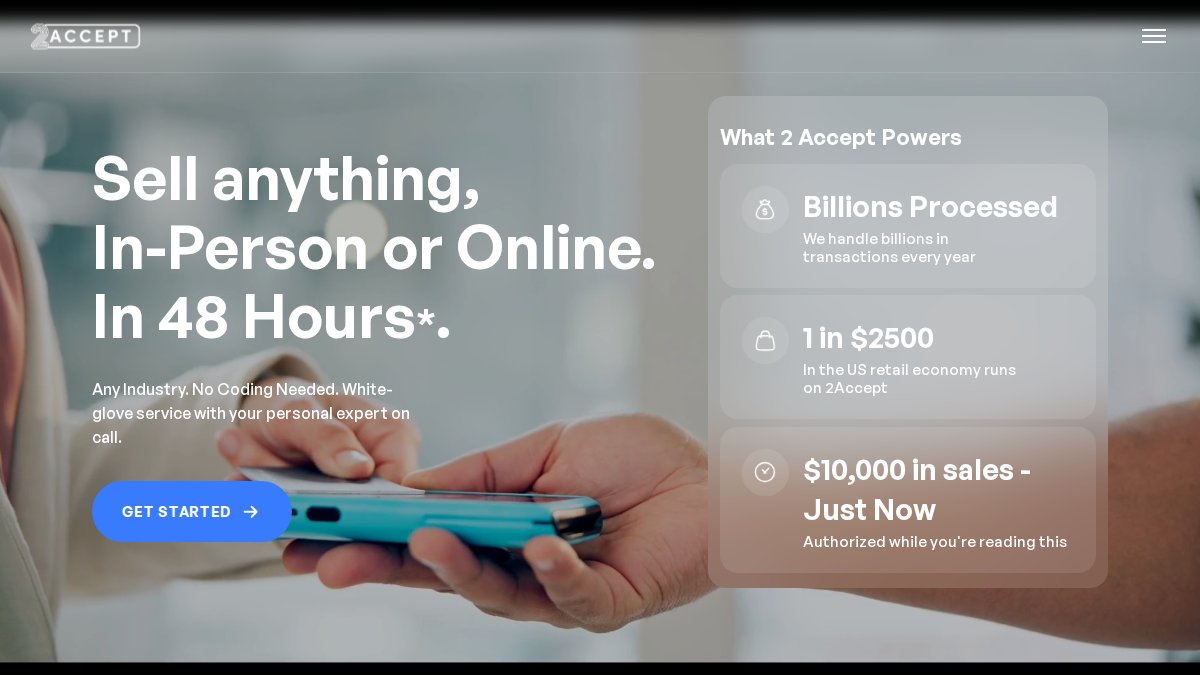
2Accept explicitly targets businesses that have been rejected elsewhere. They claim a 98% approval rate and 48-hour onboarding. They’ve built compliance frameworks specifically for industries like CBD, firearms, vape, supplements, and gaming. Their support is genuinely 24/7 with real people, which matters if you hit a snag during onboarding. However, they don’t support offshore businesses.
Merchant Card Advisors: Boutique Approach with Bank Partnerships
Merchant Card Advisors takes a consultative approach. Instead of standardized tiers and automated underwriting, they offer customized solutions based on your specific business. They work with a vast network of bank partnerships, finding the right acquiring bank for your situation. This approach takes longer upfront but results in better terms, lower processing fees, and accounts that don’t get shut down unexpectedly.
Their 24/7 personalized support means you have a real person who knows your account and business. Merchant Card Advisors specializes in helping businesses optimize their payment acceptance and achieve significant cost savings. Their no-rate-bump guarantee and transparent pricing mean you’re not paying hidden fees.
Businesses in hard-to-place industries that have been rejected before, or businesses that prioritize transparency and long-term cost savings over the fastest possible approval.
Choosing a High-Risk Payment Gateway: Speed vs. Stability
The fastest approval isn’t always the best approval. Processors that approve in 24 hours run highly automated underwriting. Automated systems are fast but less flexible. If your business doesn’t fit their standard profiles, you get rejected or approved with terms that don’t work for you.
Processors that take 5-7 days do more manual review. A human actually understands your business model and can approve you with terms that fit your situation. Speed matters if your current processor dropped you and you need to process payments again. But if you have a week, spending that time with a processor that understands your business long-term is worth it.
Ask about technical integration before committing to a processor. A processor with pre-built integrations for Shopify, WooCommerce, or common POS systems can go live in hours.
The fastest approval means nothing if the account gets shut down in three months because the processor didn’t actually understand your business model. Choose a processor that approves you for the right reasons, not just the fastest reasons.
Common Reasons for Application Denial and How to Avoid Them
Incomplete or inconsistent documentation. You submitted a business license but not a bank statement. Your SSN doesn’t match your driver’s license. Your business address on your website doesn’t match your application. Fix every detail before applying.
Unclear business model. You describe yourself as "e-commerce" but won’t specify what you sell. You claim to be a subscription service but can’t explain your chargeback rate. Be specific about what you do, how you acquire customers, and what your transaction patterns look like.
Processing history problems. You had a merchant account before and it was terminated for high chargebacks. If you have a history of account terminations, explain what changed. Did you implement chargeback prevention? Did you change your business model? Honesty matters more than the history itself.
High-risk classification without compliance preparation. You’re in CBD or firearms but didn’t bring compliance documentation. Processors won’t touch you without proof that you’re actually compliant.
Unrealistic transaction projections. You claim you’ll process $500K per month in your first month as a brand-new business. Project conservatively and show how you’ll grow.
Chargeback ratio too high. If you already have a high chargeback history from another processor, some processors will take you, but your terms will reflect the risk. Be honest about your chargeback rate and explain what you’re doing to reduce it.
Processors reject applications because they can’t verify something or something doesn’t add up. Elimination of ambiguity and complete documentation eliminates most rejection reasons.
Post-Approval Risk Monitoring and Technical Integration Timelines
Approval is the beginning, not the end. Risk monitoring and technical integration happen in parallel.
Risk monitoring starts immediately. Your processor will watch transaction patterns, chargeback rates, and customer complaints. If something looks off, they’ll flag it and potentially investigate. Respond immediately and thoroughly to any investigation email.
Technical integration is where many businesses stumble. Approval can happen in 48 hours, but integration can take days or weeks depending on your systems. If you’re on Shopify or WooCommerce, integration is plug-and-play, a few hours at most. If you’re on a custom platform or legacy system, integration requires API work or custom development.
Before choosing a processor, ask about their integration timeline and what systems they support.
Many businesses get approved and then can’t go live for weeks because technical integration wasn’t planned. Ask the processor: “How long does integration take for our specific system?”
Getting merchant account approval doesn’t require waiting weeks or settling for a processor that doesn’t understand your business. The fastest path to approval is preparation: gather your documentation, understand your risk classification, and apply to a processor that specializes in your industry.
Merchant Card Advisors works with businesses across all sectors, including hard-to-place industries that mainstream processors reject. Their consultative approach means you get customized solutions, transparent pricing with no rate bumps, and 24/7 personalized support. If you’re ready to move forward, get started with Merchant Card Advisors and connect with a payment expert who understands your business.
| Processor | Approval Timeline | Best For | Key Differentiator |
|---|---|---|---|
| PayKings | 24 hours (fastest cases) | International high-risk merchants | Transparent interchange-plus pricing |
| 2Accept | 48 hours | Rejected industries (CBD, vape, firearms) | 98% approval rate, human support |
| Merchant Card Advisors | 5-7 days | Long-term stability and cost savings | Boutique approach, bank partnerships, no rate bumps |
| SMB Global | Custom timeline | International e-commerce and dropshipping | Offshore and domestic acquiring options |
| eMerchantBroker | Custom timeline | High-volume merchants with complex histories | Specializes in hardest cases |
Frequently Asked Questions
Can high-risk businesses actually get instant merchant account approval?
No. 'Instant' approval is marketing language. Most high-risk merchant account providers offer 24-48 hour approvals after document verification, not true instant processing. Underwriting, KYC compliance checks, and AML regulations require time. PayKings claims 24-hour approval; 2Accept offers 48-hour onboarding. Merchant Card Advisors works through bank partnerships to expedite the process, but approval still depends on document quality and risk assessment. Expect 2-5 business days for most legitimate providers.
What documents are required to expedite merchant account approval?
A complete merchant account application checklist typically includes: business license, articles of incorporation, recent business bank statements (30-90 days), personal and business tax returns (2 years), government-issued ID, proof of address, and processing history if applicable. For high-risk industries like CBD or vape, you may need additional documentation: industry certifications, compliance certificates, or proof of legal operation in your state. Submitting all documents upfront, not piecemeal, is the fastest path to approval. Incomplete applications restart the underwriting clock.
What are the common reasons for merchant account application denial?
High-risk merchants face denial for: high chargeback ratios (typically above 1-2%), prior processing account terminations, incomplete documentation, misclassified business model, or insufficient business bank account history. Credit history issues, criminal background flags during KYC compliance checks, or AML red flags also trigger denials. Many processors reject entire verticals (CBD, vape, gambling) outright. High risk merchant account providers like PayKings and 2Accept specialize in approval despite these factors, but they still conduct thorough risk assessment. Being transparent about your processing history increases approval odds.
How long does technical integration take after merchant account approval?
Approval and integration are separate timelines. After merchant account approval, technical integration depends on your setup: simple payment gateway integration takes 1-3 days; custom POS or legacy system integration can take 1-2 weeks. Settlement time (when funds hit your business bank account) typically ranges from next-business-day to 2-3 days depending on your processor and merchant agreement terms. Merchant Card Advisors offers 24/7 support to minimize integration delays, but plan for at least 5-7 days from approval to first transaction processing.
What's the difference between a payment gateway and a merchant account?
A merchant account is the bank account that receives settlement funds from credit card transactions; a payment gateway is the technology that processes transactions and routes them to your merchant account. You need both. A high risk payment gateway processes transactions securely; your merchant account holds the money. Some providers bundle both (PayKings, 2Accept); others require separate arrangements. Merchant Card Advisors helps coordinate both through their bank partnership network, simplifying the setup.
This article was written using GrandRanker


